I have taught in studios. I have taught classes of twenty, thirty, sometimes forty students. I have watched, week after week, the same pattern repeat itself. The same students would arrive. Some would improve, slowly. Many would plateau. A few would get injured. A handful would quietly disappear, having decided that yoga, despite the cultural promise, did not quite work for them.
It took me a long time to understand what was actually happening in those rooms. The problem was not the students. The problem was not the yoga. The problem was the format. Group classes are designed for an average body that does not exist. A studio class teaches the same posture to twenty bodies in a sequence that suits perhaps four of them, at a pace dictated by the room rather than the individual. For the majority of students, including the ones who genuinely wanted to be transformed by the practice, this was never going to work.
This article is about why one-to-one yoga, despite being the older form and the more expensive one, is often the only format that actually delivers what yoga is supposed to deliver. This is the work I do today through private yoga sessions in KL and PJ.
What a group class cannot do
A studio teacher walks into a room of twenty students. Half of them are new. Some are recovering from injuries the teacher has not been told about. A few are senior practitioners who would benefit from more challenge. One is grieving. One is recovering from chemotherapy. One has not slept for three nights. The teacher does not know any of this. The class begins.
The class is a generalised sequence. It is built for an imagined average student. The instructions are calibrated for a body that can hear "lift your hips" and do something useful with it. For the new student who has never lifted their hips deliberately in their life, the cue is meaningless. For the senior student whose hips are already optimally placed, the cue is irrelevant. For the grieving student, the class is the wrong tool entirely. They needed something quieter than they are getting.
This is not a criticism of studio teachers. Many of them are excellent. The format itself simply cannot do what serious yoga teaching requires. There is no individual observation. There is no adjustment to today's particular body. There is no slowing down when slowing down is what is needed. The class moves on, and the bodies that needed something else continue to receive what everyone is receiving.
A studio class is excellent group exercise. It is a poor delivery system for the deeper work of yoga.
What private teaching actually changes
In a private session, the practice begins from where the student is. Not from a sequence I prepared in advance. Not from a class plan. From the body in front of me, today, with the conditions it arrived with.
If the student slept badly, the session is shorter and slower. If they are recovering from a back strain, half the sequence is adjusted around it. If they are stressed in a way I can see in their face when they walk in, we sit and do breath work for thirty minutes and skip the posture practice entirely. If they are in a strong place, ready for more, we go further than I would ever go in a group class.
This kind of teaching is not magic. It is what one-to-one attention always offers. The same is true of a personal trainer who knows your body, or a doctor who has known you for years. The work is informed by everything that has come before it. The next session builds on the last one. Nothing is repeated unnecessarily. Nothing important is missed.
For students who have been carrying chronic conditions, this matters enormously. Yoga therapy for insomnia, for chronic back pain, for anxiety, for burnout, simply does not work in a group format. The condition is specific. The student is specific. The practice has to be specific too.
The Yogic tradition was always one-to-one
This is worth saying clearly because most modern students do not know it. Until very recently, group yoga classes did not exist in the way they do today. The traditional model, the one my grandfather worked within, was one teacher and a few students. The teacher knew the students. The students knew the teacher. The work was specific and the relationship was long.
The classical texts are explicit on this. They state that a Guru is required to guide the practice safely, to modify the methods to suit each student's needs, and to ensure that nothing important is left out. They warn that a theoretical study of yoga without guidance does more harm than good.
What we now call "private yoga" is in fact the original form. The mass studio class is the modern invention. There is nothing wrong with the modern invention. It has brought yoga to many more people. But it is worth remembering, when the modern format does not deliver what you hoped, that the older form is still available. It is still the form in which most of the deeper benefits of the practice can be reliably found.
The hidden cost of group classes
Group yoga is marketed as the affordable option. A studio class in Kuala Lumpur costs perhaps RM 30 to RM 60. A private session is several times that. On the surface, the maths is clear.
But the maths is not as clear as it looks. Consider what most students experience over two or three years of studio practice. They go to class. They improve modestly. They plateau. They get injured, lightly or seriously, often without realising the injury was caused by holding a posture for which they were not prepared. They lose interest. They stop. They look back on three years of modest savings, and find that the practice did not deliver what they hoped.
Now consider the alternative. Three months of focused private work, perhaps twelve sessions, builds a foundation that genuinely changes the body. The student leaves with a daily home practice they can maintain on their own. The breath work alone, properly taught, can replace much of what they were trying to get from group classes. They have learned to listen to their own body. They no longer need a teacher every week.
The cost per session is higher. The cost per result is much lower.
When a group class is the right choice
I am not saying group classes are wrong. They are excellent for what they actually are, which is community-based group exercise with a yoga flavour. If you want to move your body twice a week in a room with other people, get a workout, sweat a little, feel better, a good studio is a perfectly reasonable choice. There is real value in the community, in the routine, in showing up. I have many friends who teach in studios and I respect their work.
What I would not do is mistake a studio class for yoga therapy. I would not expect a studio class to resolve insomnia, chronic back pain, anxiety or burnout. I would not expect a studio class to teach me breath work I could rely on for the rest of my life. I would not expect a studio class to know my body. Those are not failures of the studio. They are simply outside what the format can offer.
How to know which one you need
A simple test.
If you have a specific condition, a chronic issue, an injury you are recovering from, or a particular goal that requires expert guidance, you need one-to-one work. A studio class will not give it to you no matter how many you attend.
If you are healthy, curious, and looking for a movement practice that gets you out of the house and into a community, a studio class is fine. Begin there.
If you are somewhere in between, which is most adults over thirty-five, I would suggest a few months of private work to build the foundation, and then, if you want, a return to occasional group classes once you know your body well enough to protect it.
The decision
If you have tried studios and felt that something was missing, you are probably right. There is something missing. It is the individual attention that the practice was originally designed around.
If you would like to learn yoga in that older format, with a private yoga teacher in KL who comes to your home, send me a message. I take a small number of new students each season. The work begins as soon as we begin.
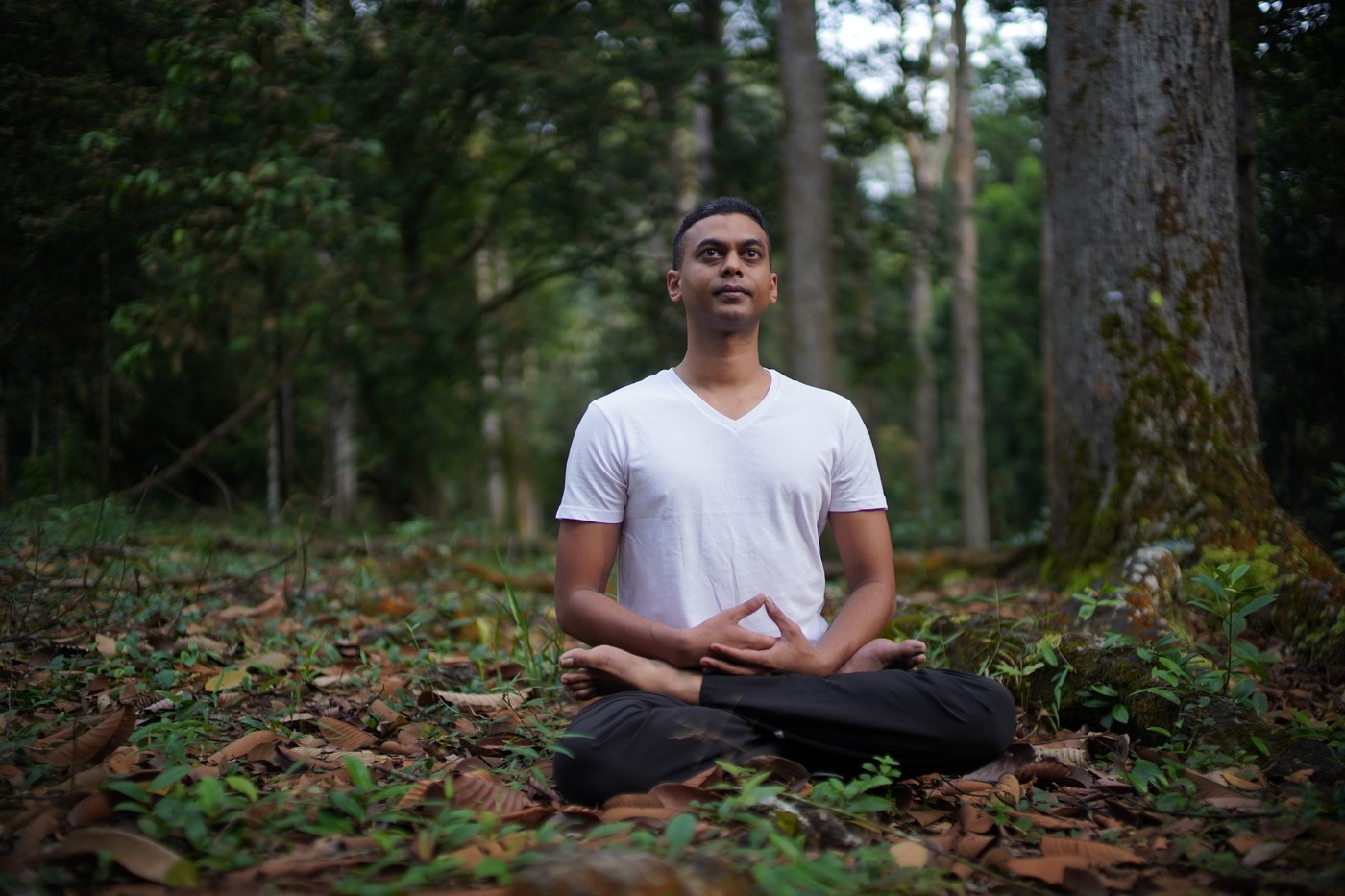
Aman Merican
Private yoga teacher in Kuala Lumpur. A third generation teacher, teaching one to one since 2007, with over 500 students taught. Read his story.