Almost every student who comes to me with broken sleep has been trying to fix it from the wrong direction. They focus on the bed, the mattress, the room temperature, the supplements, the sleep apps. These things matter a little. But they are not where the problem actually sits.
The problem is in the breath. Insomnia is almost never a sleep disorder in isolation. It is a nervous system disorder that shows itself most clearly at night. The mind cannot quieten because the body is still in low-grade activation from the day, the week, the year. Until the breath is addressed, the sleep cannot follow.
This is the work I do most often with students in my private yoga sessions in Kuala Lumpur. Three practices, taught in sequence, repeated nightly. They are simple. They are old. They have been used for centuries. They work.
Why breath comes first for sleep
The Yogis state that breath and mind are the twin faces of the same coin. The Hatha Yoga Pradipika puts it directly: "When the breath wanders, the mind also is unsteady. But when the breath is calmed, the mind too will be still."
This is not poetry. It is physiology. The breath is the only system in the body that is both automatic and voluntary. You can leave it alone and it continues. Or you can take control of it and use it to change the state of the nervous system. The vagus nerve, the main route of communication between the body and the brain, listens most closely to the breath.
This is why the breath, more than any posture, more than any meditation technique, is what I teach first to a student who cannot sleep.
The first practice: Lengthened Exhale Breath
This is the simplest of the three and the most powerful for sleep. The principle is that when the exhale is longer than the inhale, the parasympathetic nervous system, which governs rest, is activated. The sympathetic system, which governs alertness, steps back.
The Yogic texts have always emphasised this point. Expiration should be longer than inspiration. This single instruction, applied consistently, will change your sleep faster than almost anything else.
How to practise
- Lie flat on your back in bed. Arms by your sides, palms facing up. Eyes closed.
- Breathe in slowly through the nose, counting to four.
- Breathe out slowly through the nose, counting to eight. Twice as long as the inhale.
- If eight feels like too much, try six. If six is too much, try five. The exact count is not the point. The exhale must be clearly longer than the inhale.
- Repeat for as long as it takes. Most students do not make it past ten breaths before sleep arrives.
If you wake in the night and cannot return to sleep, this is the practice to come back to. Do not check the time. Do not reach for the phone. Stay in the dark and return to the breath. The body remembers.
The second practice: Alternate Nostril Breathing
For the student whose insomnia is the running-mind kind, where you lie in bed unable to stop thinking about tomorrow's meetings or yesterday's emails, this is the practice you need.
Alternate Nostril Breathing, or Nadi Shodhana, is one of the oldest practices in the tradition. The Yogis explain that the two nostrils are connected to two channels of energy in the body, called Ida and Pingala. One is active, one is restful. The two are usually out of balance, particularly in modern adults. This breathing technique balances them. When they are balanced, the mind becomes still.
This is done sitting up, not lying down. Practise it about half an hour before you intend to sleep, as part of your wind-down. Then go to bed and do the Lengthened Exhale Breath.
How to practise
- Sit comfortably with your spine tall. A cushion under the hips helps.
- Bring your right hand to your face. Use the right thumb to gently close the right nostril.
- Breathe in slowly through the left nostril, counting to four.
- Close the left nostril with the ring finger. Release the thumb. Breathe out through the right nostril, counting to six.
- Breathe in through the right nostril, counting to four.
- Close the right nostril, release the left, breathe out through the left, counting to six.
- That is one complete round. Continue for five to ten minutes.
If counting feels like work, drop it. The point is the slowing, not the math. Many students find that within a few minutes, the running thoughts have softened on their own. Modern students simply call it relief.
If you would like to learn this and other classical breathing techniques in full, my private breathwork classes in KL teach the full sequence in proper order.
The third practice: Shanti Asana
This is the practice I would give a student who has lost the ability to release. Many people with chronic insomnia have forgotten how to let the body relax even when given permission. They lie in bed with the body still gripping. The Shanti Asana, the Pose of Peace, teaches the body to release on command, piece by piece.
My mother taught this to her students for thirty years. She always preferred to call it the Pose of Peace rather than the older name, the Corpse Pose. I think she was right.
How to practise
- Lie flat on your back. Legs slightly apart, palms facing up. Close your eyes.
- Slowly, in your mind, instruct each part of your body to relax. Begin at the toes.
- Think of your ten toes. Tell them to relax. Feel them release.
- Move upward. Feet. Ankles. Calves. Knees. Thighs. Hips.
- Soften the belly. Soften the stomach. Soften the chest.
- Relax the shoulder blades, the shoulders, the upper arms, the elbows, the forearms, the wrists, the hands, the ten fingers.
- Relax the neck. The throat. The jaw. The lips. The nose. The cheeks. The ears.
- Close the eyelids more deeply. Soften the eyes. Soften the forehead.
- Bring your attention to the breath at the base of the nose. Stay there.
If done correctly and maintained for ten minutes, the Shanti Asana is equivalent to four hours of sleep. The texts say this. My students confirm it.
How to combine them for sleep
If insomnia is something you live with, here is the order I suggest.
Thirty minutes before bed, sit somewhere quiet and practise Alternate Nostril Breathing for five to ten minutes. This is the work that quietens the mind.
Once you are in bed with the lights out, begin the Shanti Asana. Move slowly through the body. Most students will fall asleep before they have finished the head.
If you wake in the night, return to the Lengthened Exhale Breath. Do not turn on the light. Do not check the time. Do not look at the phone. The phone is the worst enemy of broken sleep. It is a stress trigger disguised as a comfort.
What to expect over the first month
For students new to this work, the timeline tends to be consistent.
In the first week, falling asleep gets a little easier. The body is learning to associate the breath with rest. By the second week, the practice begins to work even on difficult nights. By the end of the first month, most students report they are no longer dreading bedtime, and the 3 AM wake-up has started to soften or disappear.
Some students recover their sleep faster. A few take a little longer. Almost all improve substantially within six weeks of consistent practice, even when nothing else has worked. If you have been carrying long-term chronic stress, the sleep change is usually the first sign that the wider work is taking effect.
When to seek more help
If your insomnia is severe, longstanding, or accompanied by anxiety or depression, breath work alone is unlikely to be enough. It will help, but as one strand inside a wider response. Please speak to your doctor. If you are on sleep medication, do not stop it without medical guidance.
For students whose insomnia is in the modern, stress-driven category, which is most of what I see in KL professionals, this work is often sufficient. Most students who arrive sleeping poorly are sleeping reasonably well within a month or two of consistent practice. Some no longer need the supplements or medications they previously did. They make that decision with their doctor, not with me.
If you would like to learn these practices in a structured way under guidance, send me a message about a personalised yoga practice at your home in KL or PJ. The breath has been waiting for you. It does not take much to begin.
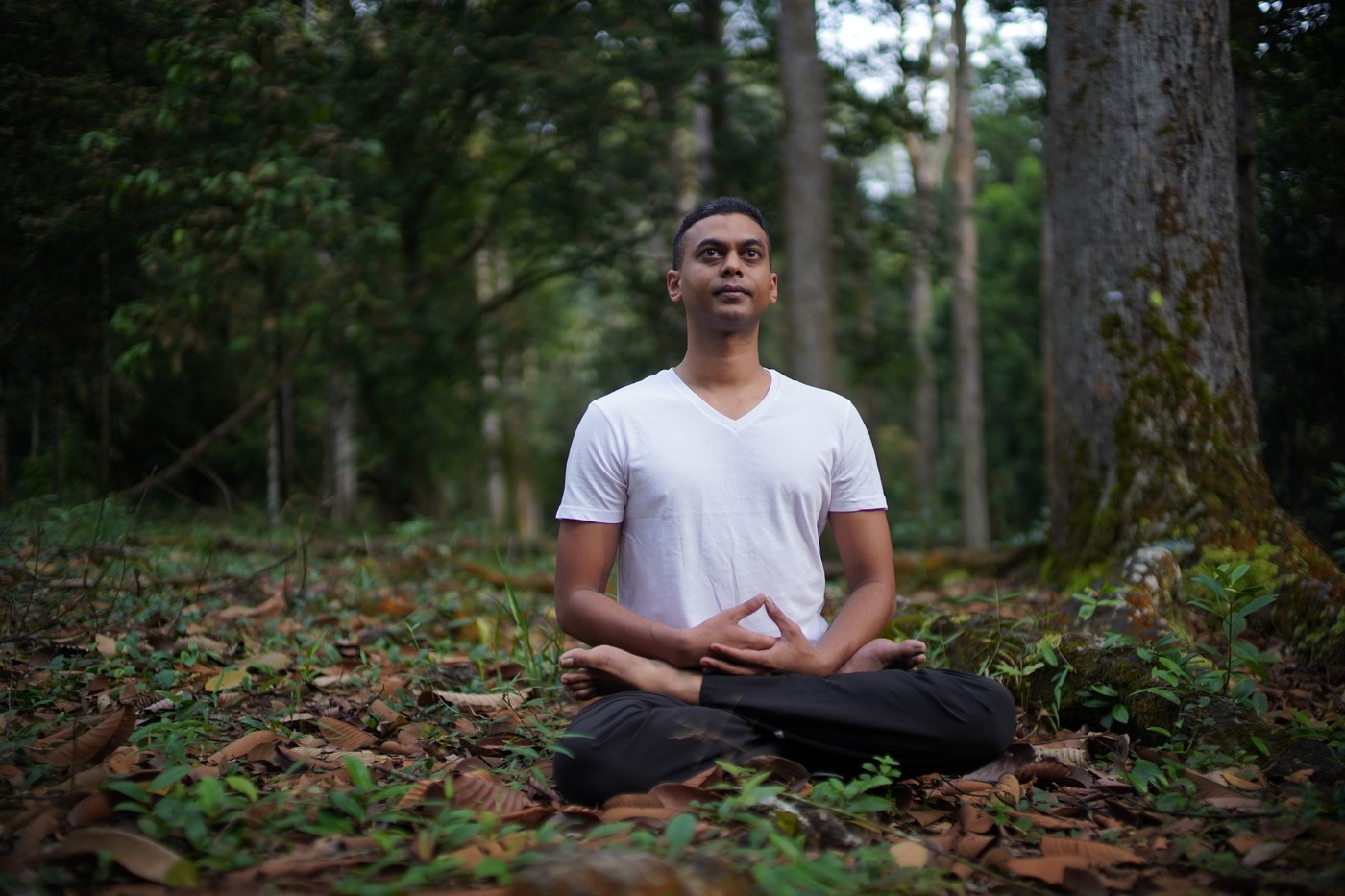
Aman Merican
Private yoga teacher in Kuala Lumpur. A third generation teacher, teaching one to one since 2007, with over 500 students taught. Read his story.